
GEN4 21700 Cells Exceed 7,000 mAh Under Extended Voltage Conditions; What the Data Actually Shows
Extended voltage testing reveals additional capacity headroom in GEN4 silicon-based 21700 cells, pointing to new design possibilities beyond conventional lithium-ion operating limits.
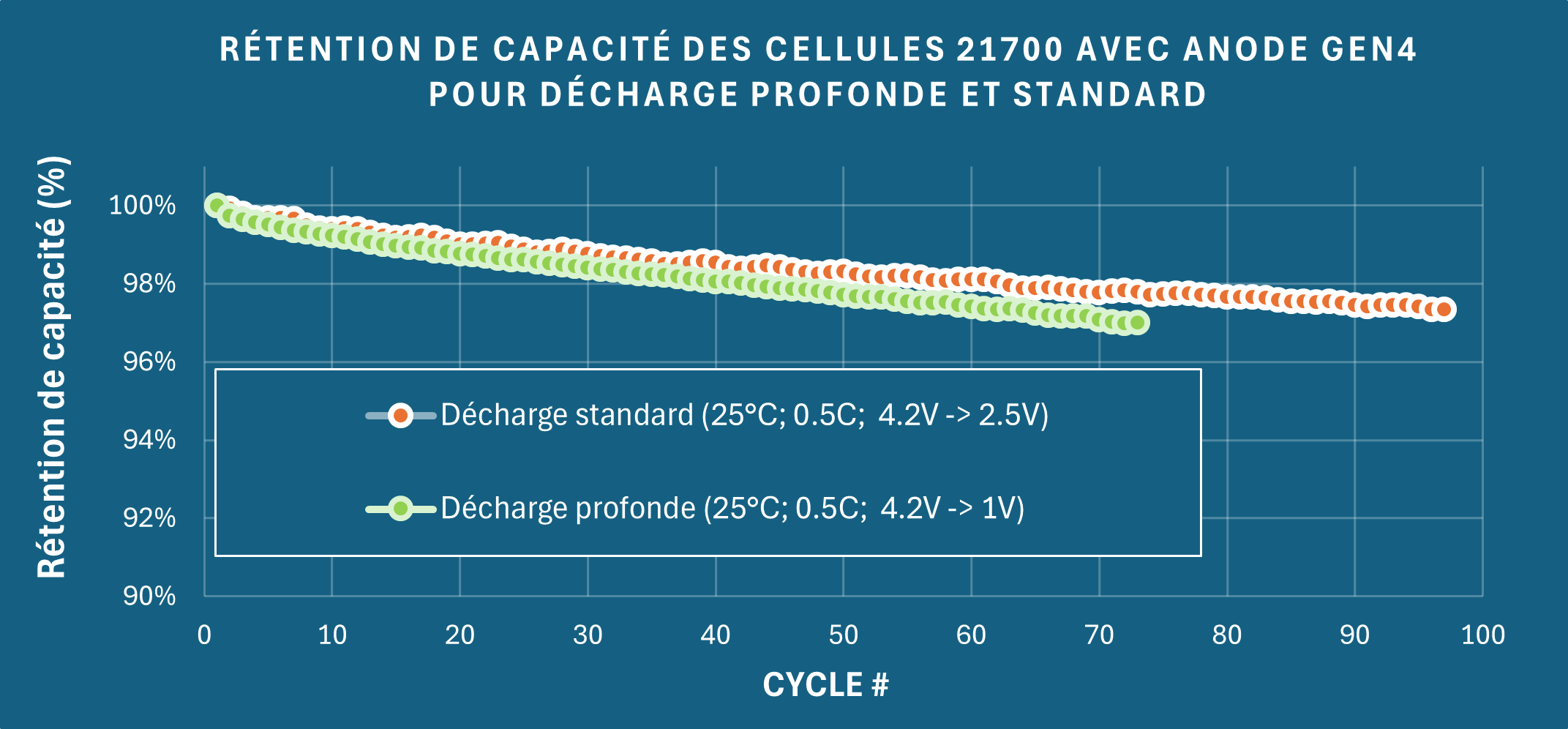
MONTREAL — The most recent test results from HPQ Silicon and its partner Novacium add a new data point to the GEN4 performance record: under an extended deep-discharge protocol (4.2V–0,55V, 0.5C, 25°C), the same 21700 cylindrical cells that previously demonstrated 6,696 mAh under standard conditions have now reached up to 7,030 mAh under a 0.55V extended cutoff, while the deep discharge cycling test (4.2V–0,55V) demonstrates capacity retention above 96% over 70 cycles.
These results were not obtained by changing the material or the cell. They were obtained by changing the voltage window. That distinction matters, and it is the central subject of this technical note.
Understanding the Extended Voltage Protocol
Standard lithium-ion testing defines the usable voltage window as 4.2V (fully charged) to 2.5V (end of discharge). These limits are not arbitrary: they reflect the stability thresholds of graphite-based anodes and conventional electrolyte systems. Discharging below 2.5V in graphite-based cells risks copper current collector dissolution, metallic lithium plating upon recharge, and accelerated capacity fade.
Silicon-based materials behave differently. The electrochemical properties of silicon allow for lithium extraction at lower potentials than graphite, meaning that meaningful capacity can remain accessible below 2.5V, provided the system can tolerate the extended window without mechanical or chemical degradation. The GEN4 extended test used a 0.55V cutoff, approximately 2V below the standard threshold.
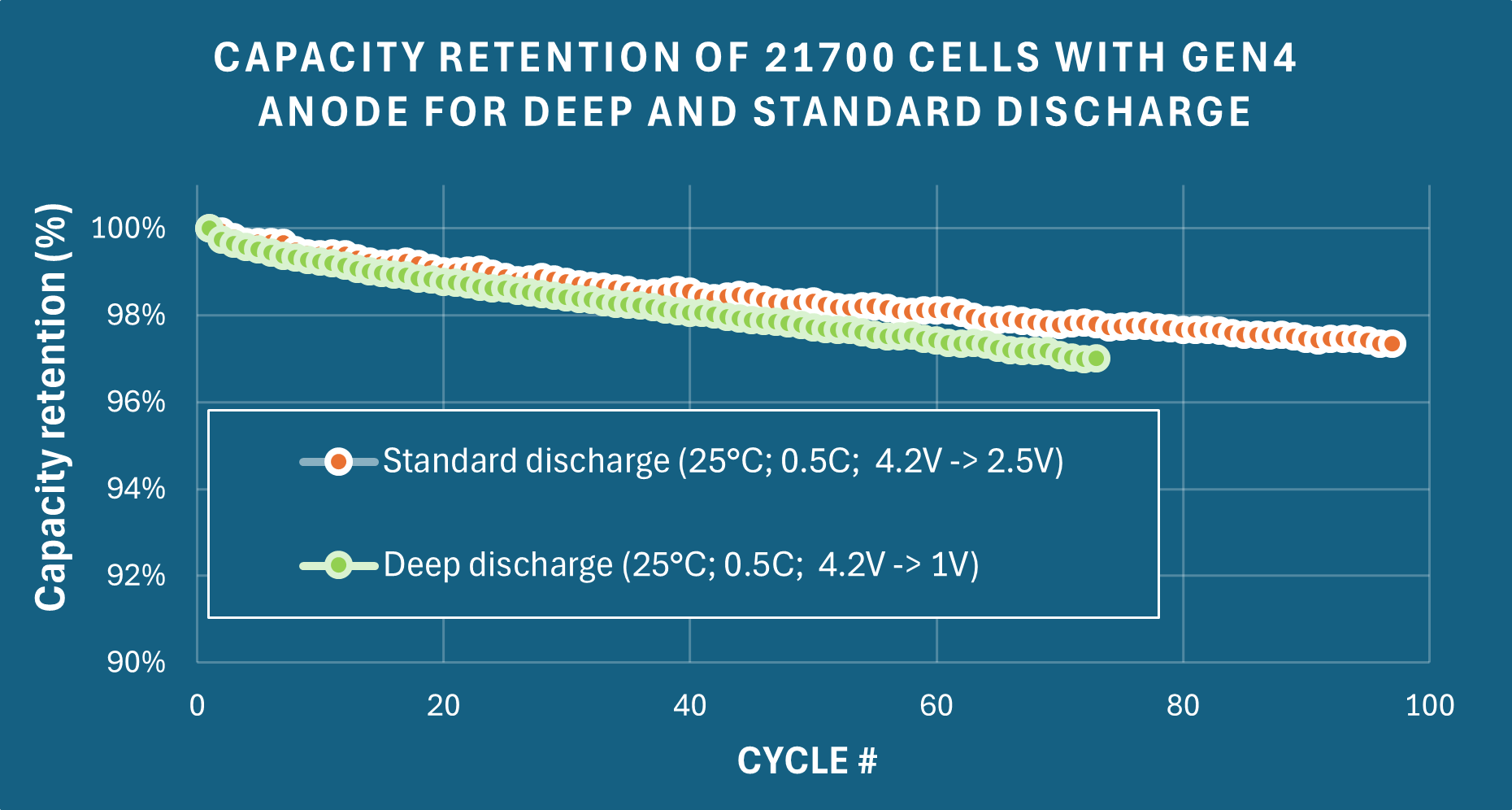
The fact that the GEN4 cell maintains stable cycling behavior across 70 cycles under deep discharge conditions (4.2V–1V, 0.5C), with capacity retention above 96%, is technically significant. It suggests that the GEN4 material architecture retains structural and electrochemical integrity under operating conditions that would be incompatible with conventional graphite anodes.
Reading the Discharge Curve: Voltage Profile and Energy Density
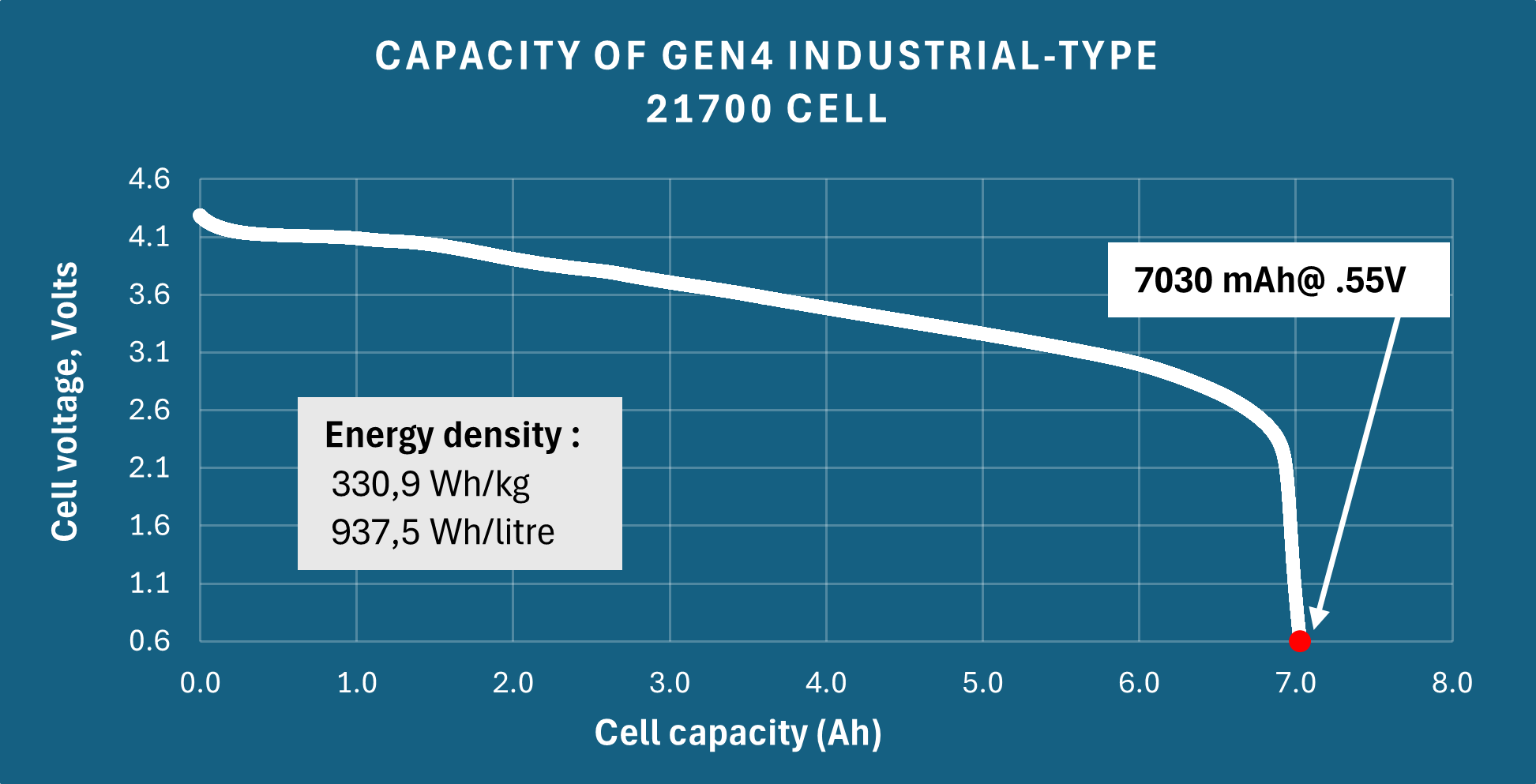
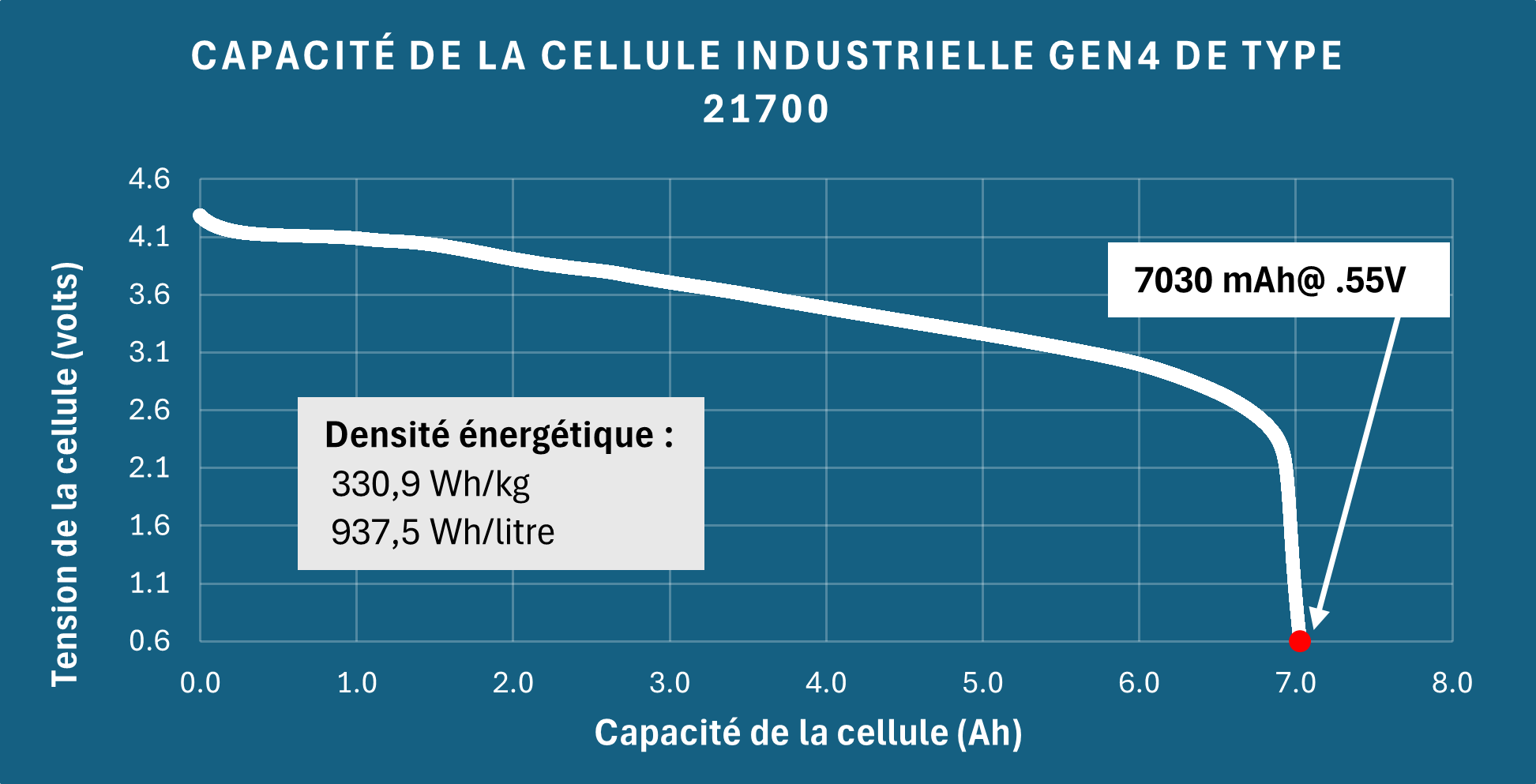
Graph 1 shows the galvanostatic discharge curve of the GEN4 21700 cell under the extended voltage protocol (4.2V–0.55V, 0.1C, 25°C). Several features of this curve warrant attention.
The voltage plateau between 4.2V and approximately 3.0V is broad and stable, characteristic of well-structured silicon-based anodes operating within their primary lithiation window. The gradual slope through the mid-discharge range reflects the progressive delithiation of the silicon phase, which differs from the flatter profile typical of graphite-dominant systems. Below 2.5V, the conventional end-of-discharge cutoff, the curve continues to deliver usable capacity down to 0.55V, confirming that meaningful electrochemical activity persists well beyond the standard operating window.
Total usable capacity reaches 7,030 mAh at the 0.55V cutoff. For reference, the same GEN4 material previously reported 6,696 mAh under standard conditions (4.2V–2.5V), meaning the extended window captures an additional ~334 mAh, or approximately 5% more energy per cycle. Commercially available graphite-based 21700 cells typically deliver between 4,800 and 5,000 mAh under standard conditions [2], placing GEN4 at a 40–46% premium over the current graphite baseline, even before accounting for the extended protocol gains.
The measured energy densities, 330.9 Wh/kg and 937.5 Wh/L, position the GEN4 cell at the upper boundary of current lithium-ion performance ranges. These values reflect the integrated area under the discharge curve across the full extended window and are directly visible in the inset of Graph 1. They represent a step beyond the 319.9 Wh/kg and 906.2 Wh/L previously reported under standard conditions, driven by the additional capacity accessed below 2.5V combined with the relatively stable voltage maintained through the extended discharge range.
The red dot in Graph 1 marks the 7,030 mAh endpoint at 0.55V.
What Cycling Stability Under Extended Conditions Implies
Cycling stability is not guaranteed when operating outside conventional voltage limits. For silicon-based materials in particular, operating under deep discharge conditions can amplify the mechanical stresses associated with volume expansion during lithiation and contraction during delithiation. If the material architecture is not engineered to accommodate these stresses across a wider range, degradation rates increase significantly.
The observation of capacity retention above 96% over 70 cycles under deep discharge conditions (4.2V–1V, 0.5C) is therefore not simply a cycling result, it is an indicator of mechanical and electrochemical resilience. Graph 2 illustrates this behavior directly: both the standard discharge and deep discharge curves maintain remarkably stable trajectories over 70 cycles, with the deep discharge protocol showing only marginally greater fade than the standard one. This confirms that the structure of GEN4, which uses a graphite-silicon architecture rather than pure silicon, continues to manage volumetric expansion effectively even when the voltage window is significantly expanded.
This is consistent with the design logic underlying GEN4: performance improvements are achieved through controlled materials engineering, not through brute-force increases in silicon content that would inherently compromise stability. The extended voltage result provides additional evidence that this architecture has meaningful headroom beyond the standard operating window.
Operational Implications: The 5% Run Time Gain
From an application standpoint, the ~334 mAh accessible in the extended voltage window translates into approximately 5% additional run time per charge cycle, relative to the already industry-leading GEN4 standard result. While 5% may appear modest in absolute terms, for energy-constrained applications it represents a non-trivial operational gain.
Consider the case of long-endurance drones, where mission range and payload capacity are directly limited by energy density. A 5% increase in usable energy, without increasing cell weight or system volume, translates directly into extended flight time or increased payload margin. Similar logic applies to portable power systems, industrial tools, and last-mile electric mobility platforms where cycle count and energy per cycle are primary performance variables.
Realizing this gain in fielded applications would require battery management systems (BMS) engineered to safely operate down to the 1V cutoff, a non-trivial requirement that differs from standard BMS design. However, the data suggests that the cell-level capability exists, and that future system design may be able to access this capacity headroom through adapted protection electronics.
Broader Significance: Silicon-Based Anodes and the Voltage Design Space
The extended voltage result also points toward a broader design question: how should battery systems be architected when the anode material enables a wider electrochemical operating range than the one inherited from graphite-era constraints?
Conventional lithium-ion cell design has been shaped by graphite’s electrochemical boundaries. The voltage limits written into standard test protocols, BMS firmware, and cell specifications largely reflect graphite behavior. Silicon-based materials do not share the same constraints: they exhibit different lithiation potentials, different expansion kinetics, and as the GEN4 results indicate the ability to remain electrochemically active at lower discharge voltages.
This suggests that the optimization frontier for silicon-based cells is not simply a matter of increasing nominal capacity under existing standards. There may be a parallel design space one in which voltage windows, BMS logic, and cell architecture are co-designed around the actual properties of silicon-based anodes rather than inherited graphite assumptions. GEN4’s performance under extended conditions is one early indication of what that design space might contain.
Caveats and Next Steps
The 70-cycle dataset provides a solid initial view of stability under deep discharge conditions. A complete performance assessment would require extended cycle life data (>300 cycles), rate capability characterization at higher C-rates, impedance spectroscopy across cycles to assess internal resistance growth, and thermal behavior mapping under extended discharge. These measurements remain ongoing.
It is also worth noting that the extended protocol used here is not currently a standard industry test methodology, and direct comparison to competitor specifications is therefore not straightforward. The result is best interpreted as an indicator of material capability rather than a directly deployable product specification.
What the data does establish with confidence is that the GEN4 material architecture remains structurally and electrochemically stable under operating conditions significantly beyond the conventional lithium-ion envelope and that the performance gains observed under standard conditions translate, and extend, when the voltage window is expanded.
These results are consistent with Novacium’s GEN4 development trajectory and support HPQ Silicon’s ongoing commercialization efforts under the ENDURA+ brand. Further technical data will be published as validation testing progresses.
REFERENCE SOURCES
[1] Internal capacity test results for a 21700-cell manufactured with GEN4 material by an industrial partner, under extended deep-discharge cycling conditions (0.1C, 4.2V–0.55V, 25°C, 50 cycles), compared to publicly available data. These results have not been independently verified and may not be representative of commercial performance.
[2] https://www.molicel.com/inr-21700-m65a/, https://diy500amp.com/products/feb-21700-battery-cell-6500mah-13a-ultra-high-capacity-energy-cell, https://www.nitecore.fr/batterie-rechargeable-21700-haute-performance-capacite-6000mah-36v-c2x40494744, https://ir.amprius.com/news-events/press-releases/detail/124/amprius-ships-new-high-performance-6-3ah-silicon-anode-cylindrical-cell-to-fortune-500-company, https://imrbatteries.com/products/eve-58e-21700-5800mah-18a-battery
[3] https://www.nature.com/articles/s41598-021-85575-x
[4] This statement constitutes forward-looking information and is subject to development risks and uncertainties