
How GEN4 Performs in Semi-Solid Systems—and What It Means for Scale, Safety, and Commercialization
This insight unpacks the performance metrics, discharge behavior, and material advantages behind GEN4’s 395 Wh/kg semi-solid battery result.
MONTREAL — The latest results from HPQ Silicon and Novacium SAS reinforce a consistent trend: GEN4 silicon anode material is not limited to a single format. Following validation in 21700 cylindrical liquid-electrolyte cells (>7,000 mAh per cell) and multiple cylindrical drone battery configurations (8S2P, 8S3P, 6S3P), GEN4 has now been successfully integrated into a semi-solid electrolyte 8S drone battery pack. This system delivers 15,900 mAh, 457 Wh of total energy, and 395 Wh/kg at a pack mass of 1,160 g.
The result was obtained under controlled testing conditions by Novacium using a commercial-grade semi-solid pack assembled by a third-party manufacturing partner. At 395 Wh/kg at the pack level, this represents, to our knowledge, one of the highest gravimetric energy densities reported for a flight-ready industrial 8S semi-solid drone battery.
Why Semi-Solid Matters for Silicon-Based Systems
Semi-solid electrolyte systems occupy a unique position in the battery landscape. They retain many of the processing and cost advantages of liquid-electrolyte systems while offering improved mechanical compliance and reduced flammability risk compared to conventional LiPo architectures.
From a materials perspective, semi-solid systems are particularly well-suited to high-capacity silicon-based anodes. Silicon’s primary challenge lies in its volumetric expansion during lithiation, which can increase by several hundred percent during charge and discharge cycles. This expansion can fracture particles, disrupt electrode integrity, and lead to capacity fade over time.
GEN4 addresses this at the material level through an optimized composite structure designed to accommodate expansion while maintaining conductivity. The semi-solid medium further enhances this by allowing closer interaction between electrolyte and active material, while tolerating dimensional changes that would compromise more rigid systems. This compatibility between GEN4 and semi-solid architecture is directly reflected in the performance results.
Interpreting the Data at Pack-Level
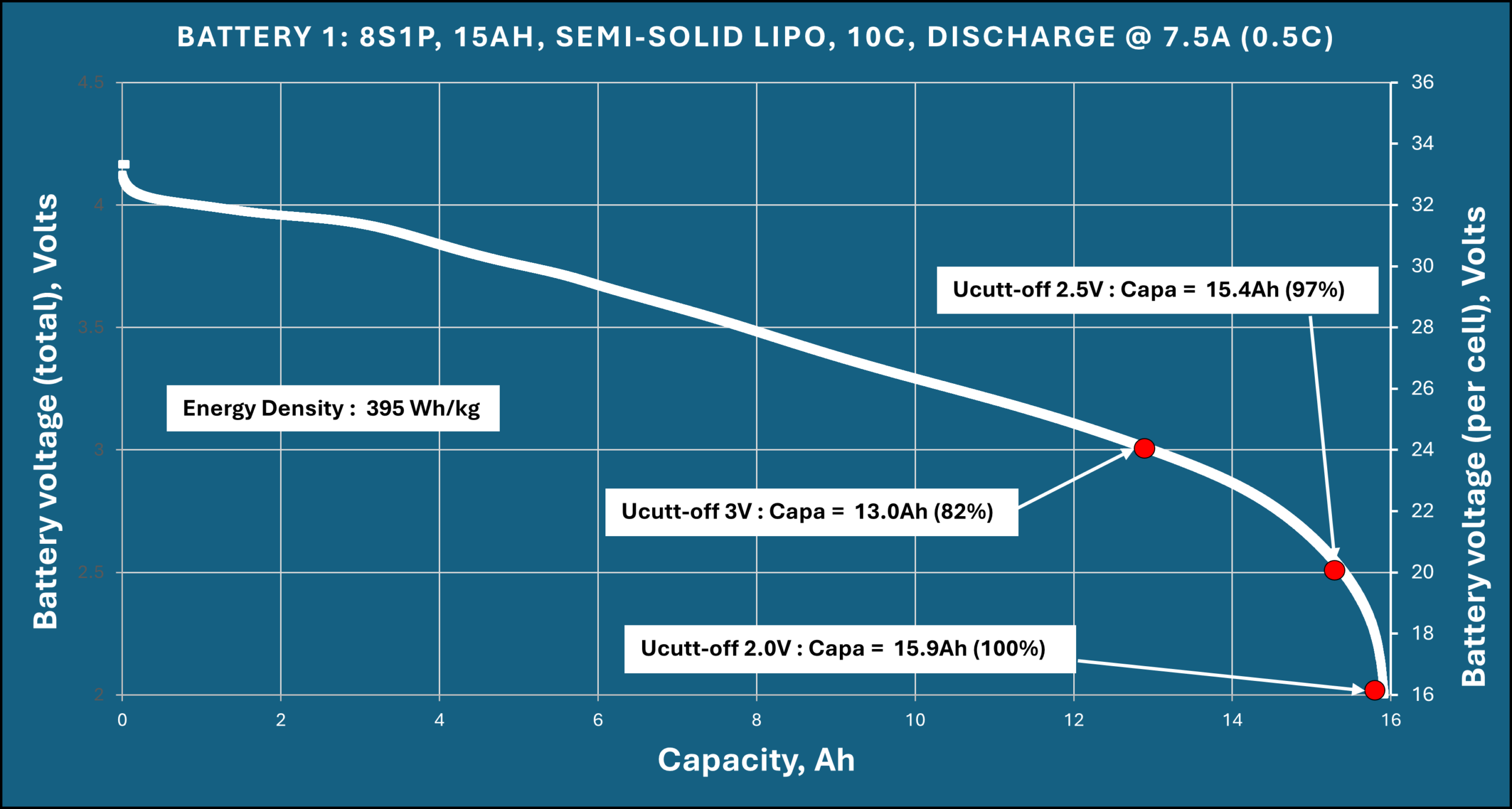
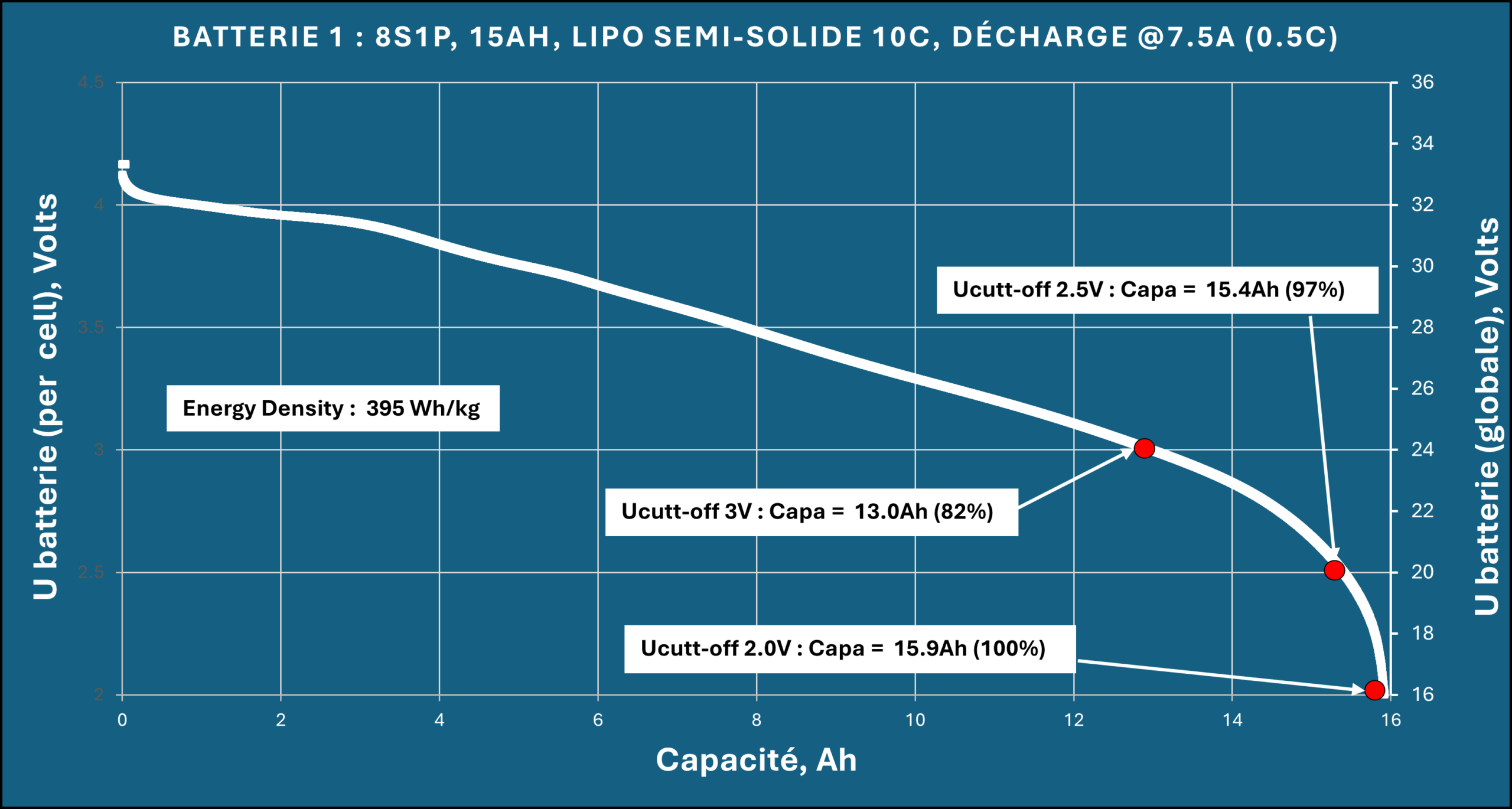
The discharge profile of the 8S1P semi-solid pack, tested at a 0.5C rate (7.5A), highlights a clearly defined operating window:
- At 3.0V per cell: 13.0 Ah delivered (82% of nominal capacity), representing a conservative, long-cycle-life operating range
- At 2.5V per cell: 15.4 Ah (97% of nominal capacity), reflecting the standard operating condition
- At 2.0V per cell: 15.9 Ah (100% of accessible capacity), representing the full capacity ceiling under this protocol
The discharge curve shows a stable and flat voltage plateau across most of the operating range, a hallmark of a well-engineered silicon composite system. The absence of early voltage drop indicates stable electrochemical behavior, which is critical for real-world drone applications where usable energy directly impacts flight time.
At 395 Wh/kg, the pack-level energy density compares favorably to conventional NMC cylindrical-based 8S drone packs, which typically operate between 290 and 320 Wh/kg. This corresponds to an estimated improvement of 23% to 36% within a sub-1.2 kg form factor.
An Architecture-Agnostic Platform
The significance of this result extends beyond a single configuration. GEN4 has now demonstrated strong performance across multiple battery formats:
- 21700 liquid-electrolyte cylindrical cells: >7,000 mAh per cell
- Cylindrical drone battery packs (8S2P, 8S3P, 6S3P): validated and commercially ordered
- Semi-solid 8S drone battery pack: 15,900 mAh and 395 Wh/kg
This cross-format consistency is a meaningful technical milestone. It confirms that GEN4’s performance is not dependent on cell geometry or electrolyte type, but instead originates from the anode material itself. This is a key requirement for broad commercial deployment across drone, mobility, and portable energy markets.
Path to Industrial Production
These results were achieved using battery packs manufactured by a qualified third-party partner under conditions representative of commercial production. This reflects a deliberate strategy by HPQ and Novacium to advance performance validation and manufacturing scale-up in parallel.
The transition toward industrial production with a semi-solid manufacturing partner signals confidence in both the material and its integration into existing production environments. The combination of GEN4 performance, semi-solid compatibility, and industrial manufacturing access establishes a scalable platform for high-energy-density battery solutions.
REFERENCE SOURCES
[1] Internal capacity testing results derived from a commercial-ready semi-solid 8S drone battery pack incorporating GEN4 silicon anode material, with the battery pack manufactured by a third-party contractor and testing conducted by Novacium under controlled conditions.
[2] Based on a 15,900 mAh (15.9 Ah) capacity, an 8S nominal voltage of 28.8 V (3.6 V/cell), corresponding to 457 Wh of total energy, and a total pack weight of 1.160 kg, resulting in ~395 Wh/kg at the battery pack level.
[3] Based on data compiled from publicly available information sources for conventional LiPo/NMC 8S drone battery packs (290–320 Wh/kg range).