
High-Capacity Silicon Anodes Advance Toward Commercial Reality as GEN4 21700 Cells Exceed 6,600 mAh
GEN4 silicon-based anodes push 21700 lithium-ion cells beyond 6,600 mAh, signaling a shift toward commercially viable high-capacity battery systems.
MONTREAL — Recent industrial-scale results from HPQ Silicon and its partner, Novacium SAS, mark a significant step toward commercially viable lithium-ion systems based on silicon anode materials.
In 21700 cylindrical cells manufactured under standard industry conditions (0.1C, 4.2V–2.5V, 25°C), Novacium’s GEN4 material has demonstrated average discharge capacities exceeding 6,500 mAh, with peak performance reaching 6,696 mAh [1]. These results not only set an all-time performance record for 21700 cells but also position the GEN4 technology at the very upper boundary of what has been reported for commercially relevant cylindrical lithium-ion formats.
Beyond the absolute capacity values, the importance of these results lies in their industrial context. Commercial graphite-based 21700 cells typically operate in the 4,800 to 5,000 mAh range, while silicon-enhanced 21700 cells reported in literature rarely exceed 6,500 mAh under comparable conditions. Demonstrating performance above this threshold within a standard cylindrical format reinforces HPQ’s positioning among a limited group of developers advancing high-capacity lithium-ion cells.
Structured Materials Strategy Driving Measurable Gains
The performance of GEN4 is the result of a multi-generation materials development strategy focused on progressively integrating silicon into the anode architecture while maintaining electrochemical stability. Graph 1 illustrates the evolution of capacity across successive material generations.
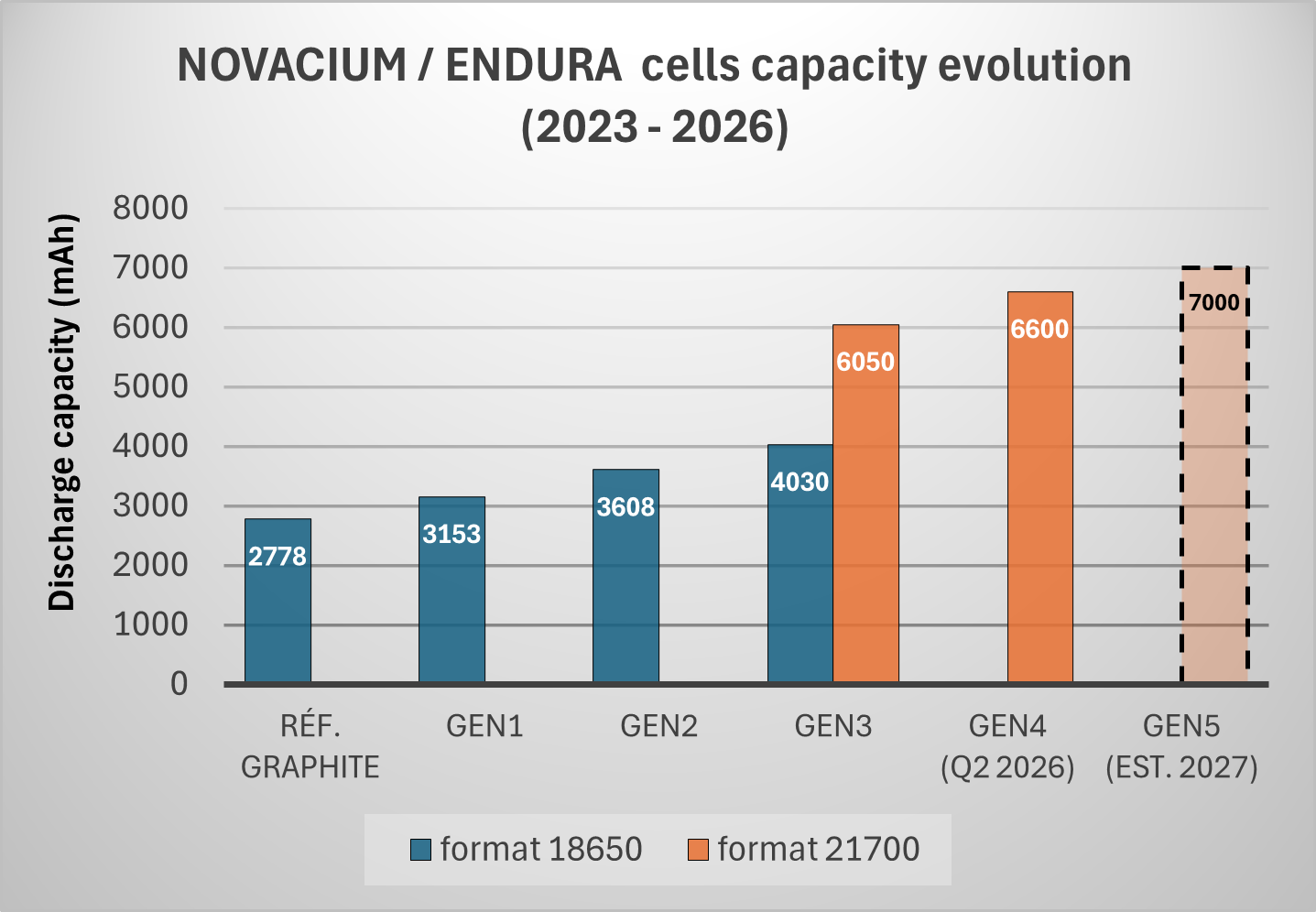
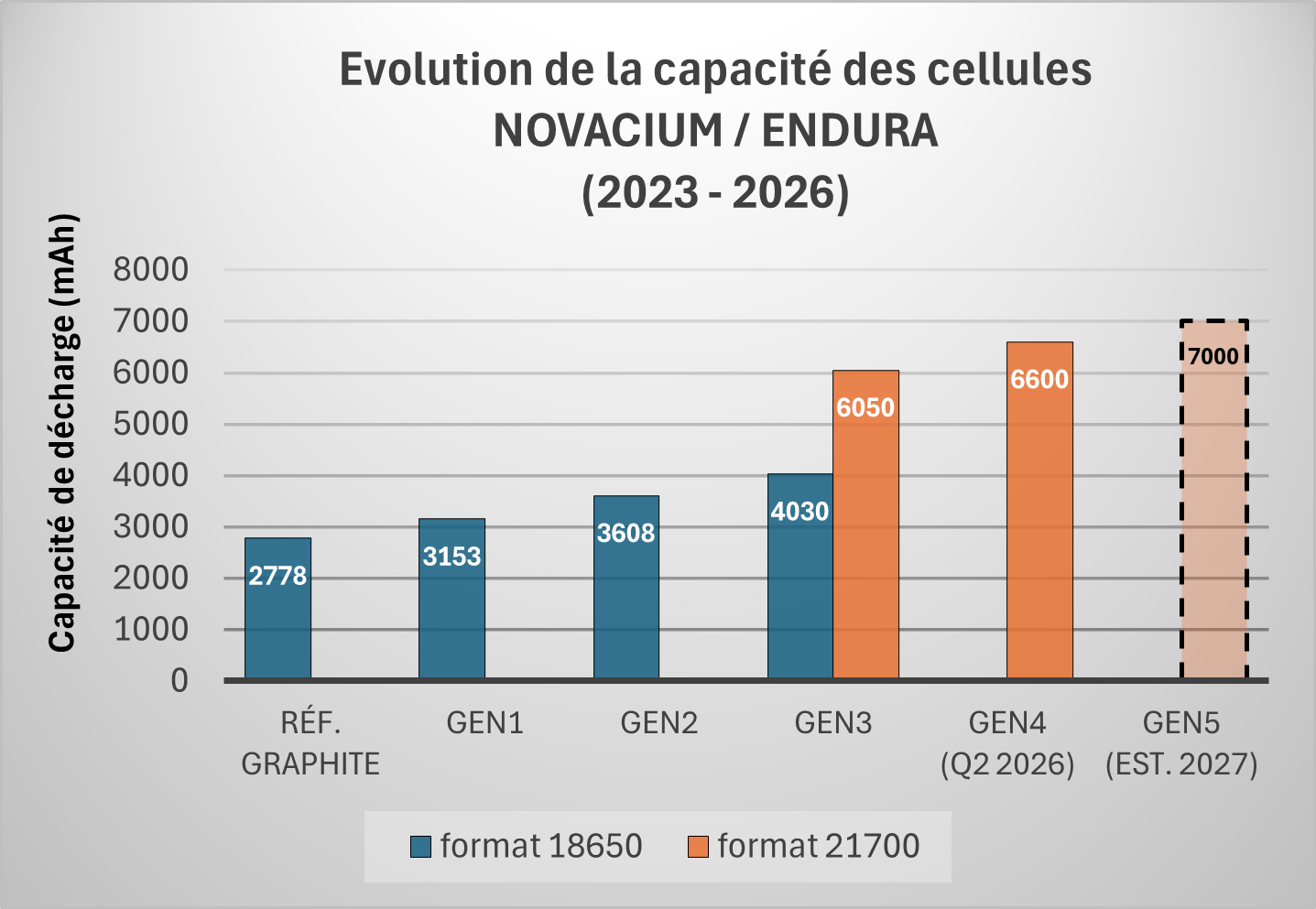
Starting from the far left, the first bar shows the capacity of the 100% graphite reference battery at approximately 2,778 mAh in 18650 formats. Successive bars then show the capacity achieved with GEN1 material (~3,153 mAh), GEN2 material (~3,808 mAh), and GEN3 material (~4,030 mAh) in 18650 formats, alongside their 21700 counterparts, which reach ~6,050 mAh for GEN3. GEN4, measured in Q2 2026, achieves 6,600 mAh in 21700 formats, with GEN5 projected at an estimated 7,000 mAh by 2027.
This progression reflects more than incremental gains. While not yet fully optimized GEN4 delivers an improvement of over 45% compared to the graphite benchmark in 18650 format and approximately 9% over GEN3 in the 21700 formats. Importantly, these gains are achieved using a graphite–silicon composite structure rather than pure silicon, indicating that performance improvements are being realized through controlled materials engineering rather than increased instability.
The central technical challenge remains the volumetric expansion of silicon during lithiation, which can reach several hundred percent and lead to mechanical degradation, particle fracture, and loss of electrical connectivity. GEN4 addresses this through an engineered anode material architecture designed to mitigate expansion effects while maintaining conductivity and structural integrity. While the material itself continues to be refined, this approach reflects a transition from theoretical capacity enhancement toward engineered stability within a commercially relevant system.
Energy Density, Discharge Behavior, and Industrial Compatibility
The electrochemical performance of GEN4 extends beyond capacity into energy density and discharge behavior. The 21700 cell achieved a measured discharge capacity of 6,696 mAh at a 2.5V cutoff, with a gravimetric energy density of 319.9 Wh/kg and a volumetric energy density of 906.2 Wh/L. These values position the system at the upper end of current lithium-ion performance ranges [2].
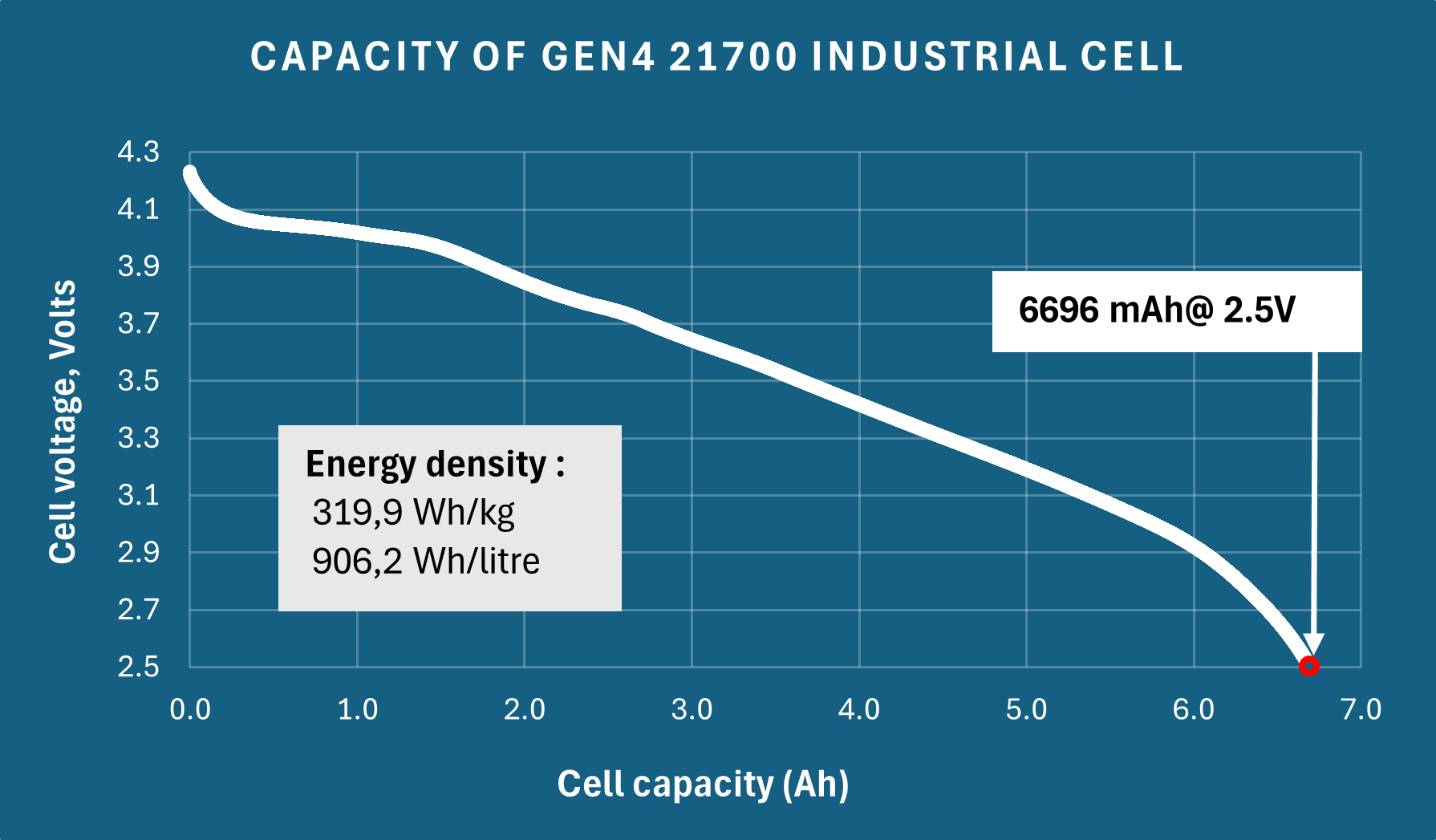
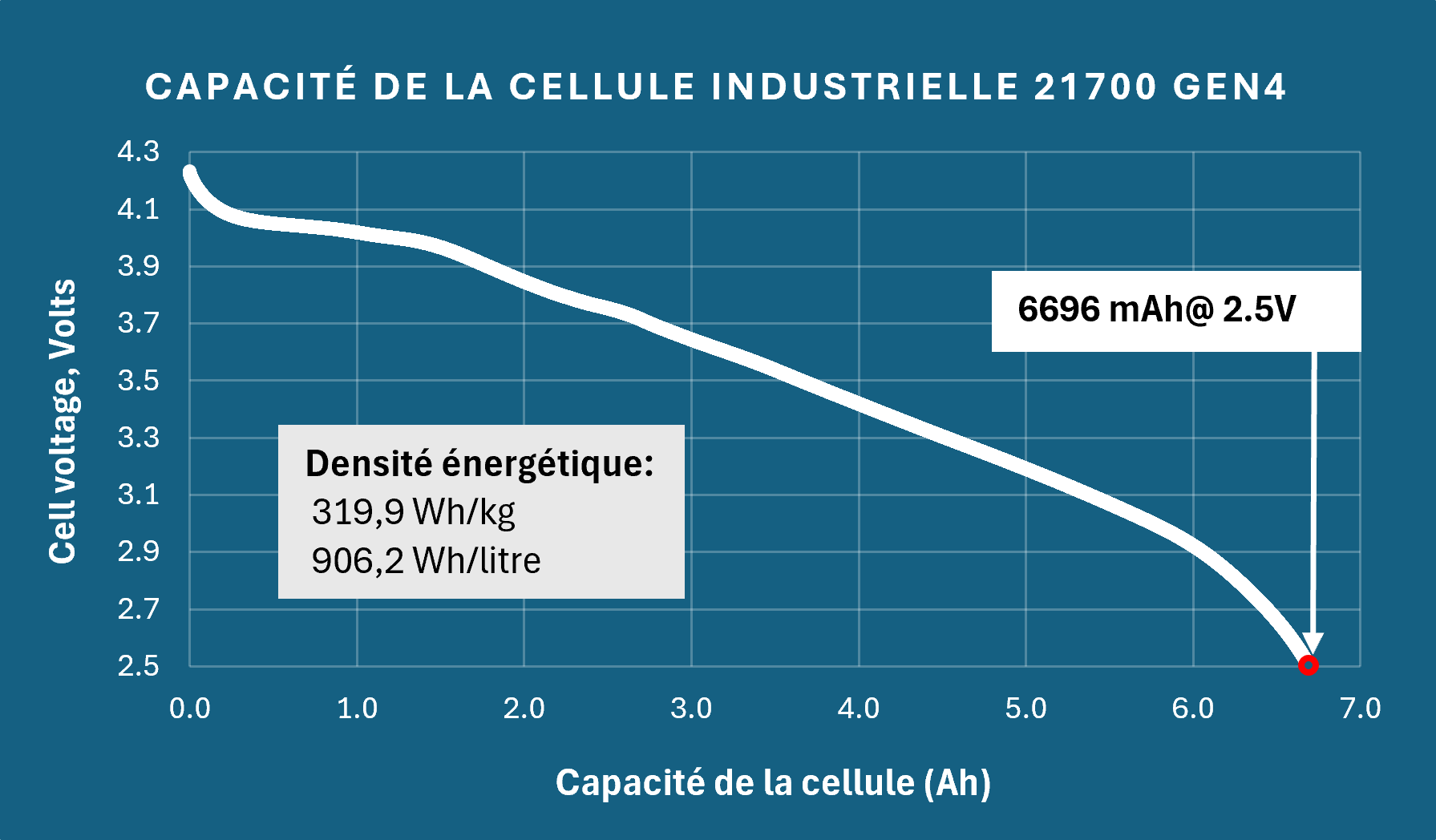
The galvanostatic discharge curve provides additional insight into system performance. The voltage response across the discharge window indicates stable electrochemical behavior, with usable capacity maintained down to 2.5V. This is critical, as real-world applications depend on usable energy rather than nominal capacity. Stability across this range suggests that the material is not only achieving high capacity but doing so within an operationally relevant voltage profile.
At the system level, these gains translate directly into performance advantages. Higher gravimetric energy density reduces system weight for a given energy requirement, while higher volumetric density enables more compact designs. These characteristics are particularly relevant for applications such as electric mobility, long-endurance drones, and portable energy systems, where energy density directly constrains performance.
Equally important is the manufacturing context. The GEN4 material is produced using a proprietary process described as both high-performance and low-cost, while remaining compatible with existing lithium-ion manufacturing infrastructure. This compatibility suggests a practical pathway to industrial adoption, allowing integration into established production lines without requiring fundamental changes to electrode fabrication or cell assembly processes.
Toward Commercial Validation and Market Positioning
The data positions GEN4 within a narrow group of high-capacity cylindrical cells exceeding 6,000 mAh, a segment currently limited to a small number of manufacturers globally. The demonstrated ability to exceed 6,500 mAh under industrial conditions, while maintaining electrochemical stability, reinforces HPQ’s positioning within a differentiated and high-value segment of the lithium-ion market.
At the same time, the results indicate that silicon-based anode materials are approaching a point where performance gains can be realized without compromising structural integrity. This marks a shift from experimental validation toward industrial applicability. While additional data on cycle life, rate capability, impedance growth, and thermal stability will be required to fully assess long-term performance, the current results establish a strong technical foundation.
In this context, GEN4 represents a meaningful convergence of capacity, stability, and manufacturability. The ability to deliver high energy density within an industrially compatible framework suggests that HPQ and Novacium are advancing toward a commercially deployable solution, with the potential to redefine performance expectations within the 21700 lithium-ion format.
REFERENCE SOURCES
[1] Internal capacity test results for a 21700-cell manufactured with GEN4 material by an industrial partner, under standard industry conditions (0.1C, 4.2V–2.5V, 25°C) compared to publicly available data.
[2] https://www.molicel.com/inr-21700-m65a/, https://diy500amp.com/products/feb-21700-battery-cell-6500mah-13a-ultra-high-capacity-energy-cell, https://www.nitecore.fr/batterie-rechargeable-21700-haute-performance-capacite-6000mah-36v-c2x40494744, https://ir.amprius.com/news-events/press-releases/detail/124/amprius-ships-new-high-performance-6-3ah-silicon-anode-cylindrical-cell-to-fortune-500-company, https://imrbatteries.com/products/eve-58e-21700-5800mah-18a-battery