
The Value-Creation Phase

For nearly a decade, HPQ Silicon has focused on answering a series of technical questions.
Could silicon be produced differently? Could fumed silica be manufactured with a significantly lower environmental footprint? Could advanced battery materials deliver higher performance while remaining compatible with existing manufacturing infrastructure? Could new approaches to hydrogen production address growing demands for energy autonomy and resilience?
These questions have shaped much of our work.
Today, however, I believe a more important question is emerging:
What happens when proven technologies meet markets that are actively searching for solutions?
That question matters because value in technology companies is rarely created during invention alone. Innovation captures attention. Commercial adoption creates value.
For years, success in the advanced materials sector was measured primarily through technical milestones: laboratory validation, pilot-scale demonstrations, intellectual property development, and performance improvements. Those achievements remain essential, but they are only part of the story.
Increasingly, the conversation is shifting from what a technology can do to where it can be deployed, who can use it, and how quickly it can create economic value.
This is the transition that many technology companies spend years working toward. It is also the phase where markets often begin to reassess what those technologies may ultimately be worth.
A Different Market Environment
The timing of this transition is not occurring in isolation.
The geopolitical and industrial landscape has changed dramatically since many advanced-material projects were first conceived.
Governments across North America and Europe are investing heavily in critical minerals, battery supply chains, strategic manufacturing capacity, and energy security. Concerns about supply-chain resilience and technological sovereignty have transformed the way industries evaluate new technologies.
Performance remains important. Increasingly, however, so does origin, scalability, and the ability to strengthen domestic industrial ecosystems.
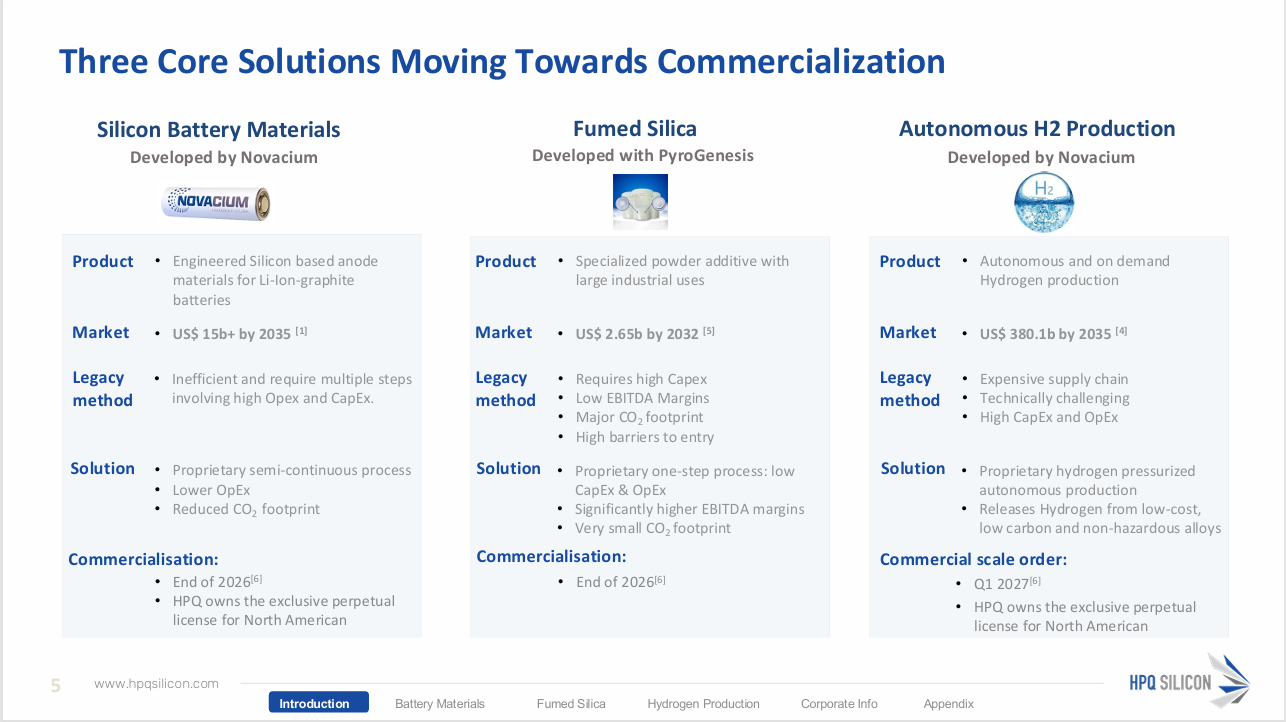
Battery technologies are a clear example. Demand for higher-energy-density storage solutions continues to grow across transportation, electronics, robotics, defense, and industrial applications. Through HPQ’s strategic investment in Novacium and our exclusive North American commercialization rights, we have seen how rapidly the market’s expectations are evolving. The discussion is no longer limited to laboratory performance. It is increasingly focused on industrial deployment and market readiness.
Hydrogen technologies are benefiting from similar trends. Energy resilience, decentralization, and security have become priorities for both governments and industries seeking greater control over critical infrastructure and energy systems.
Together, these developments are creating opportunities that simply did not exist at the same scale a decade ago.
From Innovation to Adoption
While batteries and hydrogen often capture headlines, industrial materials remain equally important.
Fumed silica is used in a wide range of applications, including specialty chemicals, coatings, electronics, batteries, and advanced manufacturing. Markets such as these tend to move methodically, but once adoption occurs, they often reward innovation with durable commercial positions and meaningful barriers to entry.
What is encouraging today is that multiple technology sectors are reaching similar inflection points. The discussion is becoming less about proving concepts and increasingly about creating commercial outcomes.
Historically, some of the most significant value creation occurs when technologies move from validation to adoption. The focus shifts from scientific possibility to market opportunity, from technical milestones to business execution, and ultimately from development spending to revenue generation.
Innovation remains the foundation of every successful technology company. But innovation alone is rarely what defines long-term success.
The companies that create lasting value are those that successfully convert technical achievement into commercial relevance.
For years, HPQ focused on developing technologies to address important industrial challenges. Today, we are increasingly focused on positioning those technologies within markets that are actively seeking solutions.
Innovation built the foundation.
The opportunity now is to build value upon it.
Bernard Tourillon
Chairman, President and CEO
HPQ Silicon Inc.