
Why UL 1642 Certification Is an Important Commercial Milestone for Next-Generation Lithium-Ion Batteries
Independent certification marks another commercialization milestone for HPQ’s next-generation silicon-anode battery technology, validating its readiness for customer qualification and commercial evaluation.
The successful commercialization of advanced lithium-ion battery technologies depends not only on improvements in electrochemical performance, but also on compliance with internationally recognized safety standards. Regardless of advances in energy density, cycle life, or charging performance, a battery platform cannot progress toward widespread commercial adoption without first demonstrating that it satisfies the engineering and safety requirements governing its integration into commercial products. Within the lithium-ion industry, UL 1642 certification represents one of the most widely recognized independent validations of cell safety and an important milestone in the transition from laboratory development to commercial qualification.
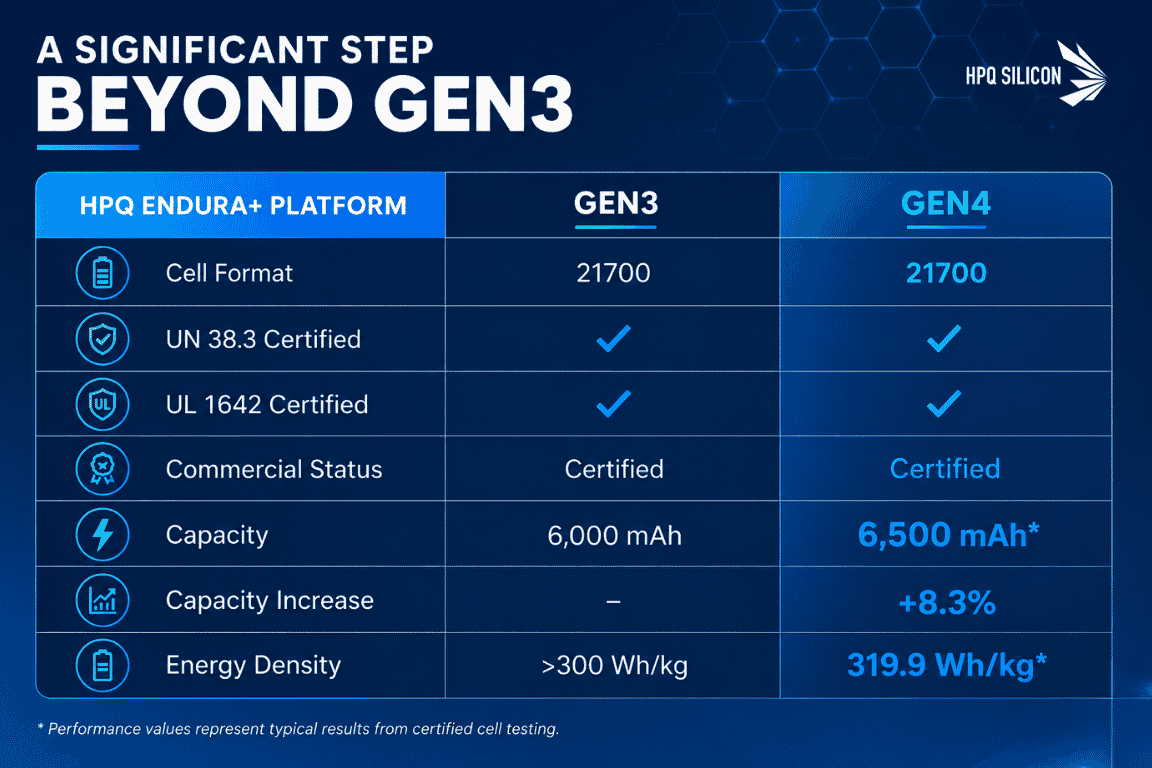
HPQ’s recent certification of its HPQ ENDURA+ Gen4 21700 lithium-ion cell platform to UL 1642 represents a significant advancement in the maturation of the Company’s silicon-anode battery technology. Beyond confirming compliance with an internationally recognized safety standard, the certification provides independent verification that the Gen4 platform meets rigorous electrical, thermal, and mechanical safety requirements and delivers a measurable improvement in electrochemical performance over the previously certified Gen3 platform.
Specifically, the Gen4 cell is certified at 6,500 mAh, representing an 8.3% increase over the Company’s previously certified Gen3 platform, while continuing to meet the safety requirements established under UL 1642.
For developers of advanced battery technologies, this type of third-party validation serves as an important mechanism for reducing technical uncertainty. Original equipment manufacturers (OEMs), battery pack integrators, and industrial customers generally require independently certified cells before initiating qualification programs, integrating prototypes, or evaluating products. Consequently, certification functions as an objective measure of engineering maturity, providing confidence that a battery platform has progressed beyond laboratory performance claims and is suitable for commercial assessment.
Technical Significance of UL 1642 Compliance
Published by UL Solutions, UL 1642 establishes one of the industry’s most widely adopted safety standards for lithium-ion cells intended for commercial applications. Unlike performance testing, which evaluates parameters such as capacity, energy density, or cycle life, UL 1642 is designed to verify that individual cells continue to operate safely under both normal operating conditions and reasonably foreseeable abuse scenarios.
Certification requires independent evaluation through a series of standardized electrical, thermal, and mechanical tests intended to identify potential failure mechanisms before a product reaches the marketplace. These evaluations typically include external short-circuit testing, overcharge exposure, forced discharge, impact resistance, crush testing, vibration, mechanical shock, and elevated temperature assessments. Throughout the testing sequence, laboratories monitor the structural integrity and electrochemical stability of the cell to verify that it does not exhibit hazardous behaviors such as fire, explosion, or uncontrolled rupture under prescribed conditions.
From an engineering perspective, meeting these requirements becomes increasingly demanding as battery performance improves. Greater energy density generally results in a higher concentration of stored electrochemical energy within the same physical volume, increasing the importance of electrode stability, separator integrity, electrolyte formulation, current collector design, and thermal management. Consequently, demonstrating compliance with UL 1642 while simultaneously increasing capacity represents more than regulatory achievement; it provides evidence that performance improvements have been realized without compromising the safety characteristics expected for commercial deployment.
Engineering Implications for Silicon-Anode Commercialization
The significance of this certification is particularly relevant for silicon-based anode technologies. Silicon has a theoretical specific capacity substantially greater than that of conventional graphite, making it one of the most actively investigated anode materials for next-generation lithium-ion batteries. However, repeated lithiation and delithiation cycles cause significant volumetric expansion, which has historically limited commercial implementation due to particle fracture, unstable solid-electrolyte interphase formation, and accelerated capacity degradation.
Modern silicon-anode development has therefore focused on engineering material architectures that accommodate these mechanical stresses while maintaining long-term electrochemical stability and compatibility with conventional lithium-ion manufacturing processes. HPQ’s collaboration with Novacium is directed toward this objective by developing silicon-based anode materials that improve energy density while remaining compatible with existing industrial manufacturing infrastructure. This compatibility represents an important commercial advantage, enabling manufacturers to pursue higher-performance battery chemistries without substantial modifications to established production lines.
From a commercialization perspective, UL 1642 certification represents considerably more than a regulatory requirement. It provides independent validation that a battery platform has achieved a level of engineering maturity consistent with commercial product development and supports subsequent customer qualification, battery pack integration, industrial evaluation, and broader commercialization activities. While certification alone does not guarantee market adoption, it establishes one of the fundamental technical prerequisites required before advanced battery technologies can progress toward large-scale industrial deployment.
The successful certification of HPQ ENDURA+ Gen4 therefore demonstrates more than compliance with an internationally recognized safety standard. It establishes the Company’s continued ability to advance successive generations of silicon-anode battery technology while maintaining the engineering discipline necessary for commercial applications. As global demand continues to increase for higher-energy lithium-ion cells across mobility, energy storage, telecommunications, robotics, defense, and industrial markets, independent safety validation through UL 1642 provides an important technical foundation supporting customer confidence, industrial partnerships, and the continued commercialization of the HPQ ENDURA+ platform.
Bernard Tourillon
Chairman, President and CEO
HPQ Silicon Inc.